

Introduction
You don’t need to be a real estate expert to buy a vacation rental property that can make you money.
Many online lists claim to give you the “best Airbnb markets” or the “top vacation rental spots,” but following them without thinking can lead to expensive mistakes.
In this blog, I’ll show you a straightforward way to find promising markets, evaluate how well a property might perform, and make wise decisions.
You’ll also see how I applied these methods to The Belmonte Penthouse, a great example of how a carefully chosen market can lead to great results.
Finding Your Vacation Rental Market
Think About Your Future Guests
Start by asking yourself: What kind of guest do I want to host?
Your ideal guest profile shapes your vacation rental market selection. When I did my research to start investing in short-term rentals, I thought of these potentially profitable guest types:
- Elderly guests
- Medical tourists seeking proximity to hospitals.
- Families on vacation who prioritize kid-friendly amenities.
Once you define your guest type, brainstorm 25 potential markets.
Why 25?
Because we want to maximize our chances of finding a truly profitable vacation rental market, if we analyze only five markets, our best option is limited to those five. Expanding to 25 significantly increases our odds of picking a winning location.
Pro Tip: Use a map to plot airports, tourist hubs, and secondary cities. This often reveals nearby markets with untapped potential that other investors overlook.
And remember, I’m here to help at any point. You can speak with me via a phone consultation.
You can also join my program and discuss your research during one of our live calls.
Looking At The Data
Data is your friend, but it’s not always accurate.
Avoid making investment decisions based on a single data source. I always compare data from at least two different tools to cross-check performance.
Avoid making investment decisions based on a single data source. I always compare data from at least two different tools to cross-check performance.
For my latest research, I used AllTheRooms (use code OPTIMIZE50 for 50% off) and AirDNA.
Why Is Data Sometimes Misleading?
All data sources require assumptions and filtering to present information in an organized manner. This means some information can be outdated, incomplete, or skewed based on how it’s collected.
That’s why cross-verifying is crucial to avoid bad investments if you’re planning to buy a vacation rental property.
Key Short-Term Rental Metrics To Analyze
Once I gather my data, here are the core metrics I focus on:
- Nightly Rate: What is the average price per night?
- Annual Occupancy: How often is the property booked?
- Annual Revenue: You get this number by multiplying the occupancy X 365 days X the nightly rate.
- Number of Reviews on the First Page: My theory is that a market with more reviews on the first page of an Airbnb search is a stronger market.
You might be wondering why I am looking at the number of reviews. Because if a market has an average of 200+ reviews per listing, it means Airbnb has been active in that area for many years, a positive indicator of market stability.
Makes sense? Good. Let’s move on.
Micro-Neighborhoods: The Hidden Goldmines
Even in a top-performing city, not all neighborhoods are created equal.
Micro-neighborhoods are small pockets within larger areas that can offer drastically different returns.
They can be as small as a particular street in a larger neighborhood. I cover this in detail in Part 2: Vacation Rental Market Analysis of my latest book Profitable Properties.
How Can You Find Them?
The hard way is to visit the area for yourself, exploring and observing activity patterns.
The easy way is to use PriceLabs Market Dashboard (30-day free trial, plus $10 off first payment) to analyze market data at a granular level.
A great example is The Belmonte Penthouse. I specifically chose its location based on micro-neighborhood insights, and this is what PriceLabs has to say about the area.
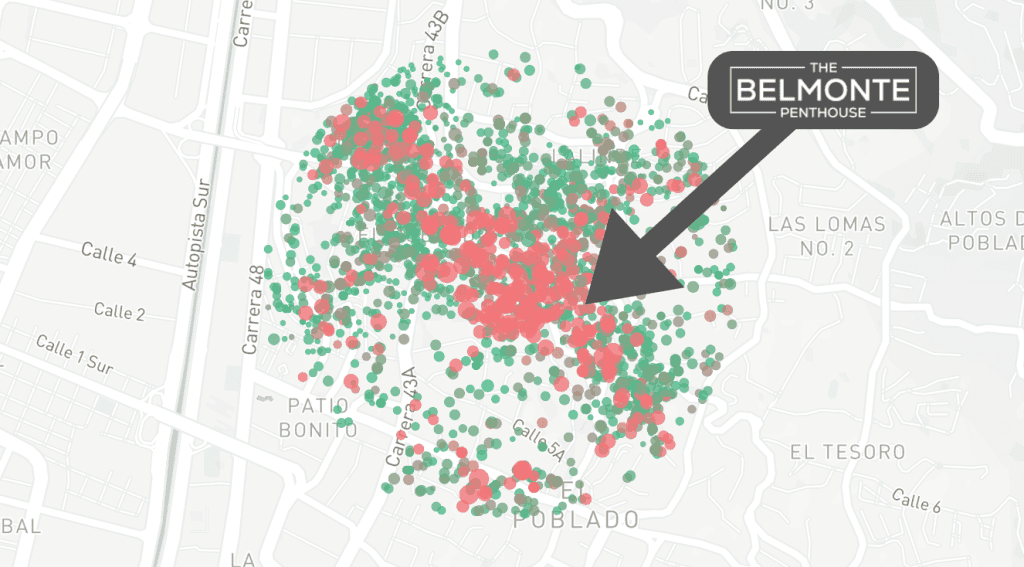
Green is bad; red is good.
As you can see, The Belmonte Penthouse is located in a profitable area. I learned of this tool after buying it, so the fact that it is in a “good” area according to PriceLabs gives me confidence in their Market Dashboard.
Finding The Actual Airbnb Properties
Once you’ve selected a promising market, it’s time to find a property. But instead of making blind assumptions, a smart tactic is to identify poorly managed listings and assess their improvement potential.
It makes your life so much easier
Why Look for Badly Managed Airbnb Listings?
The more assumptions you make about a property’s potential, the greater the risk of a bad investment.
But if you can find a property that’s underperforming due to poor management, you’re reducing risk because you know exactly how to improve it.
Look for properties on Zillow by searching for keywords like Airbnb, short-term rental, etc.
How Much More Can You Make By Being A Good Airbnb Host?
Let’s say you’ve found the actual listing; now comes the fun part.
Analyze their reviews and see if the complaints are about cleanliness, communication, or lack of amenities. These are fixable problems that create big opportunities for a new owner (ideally you).
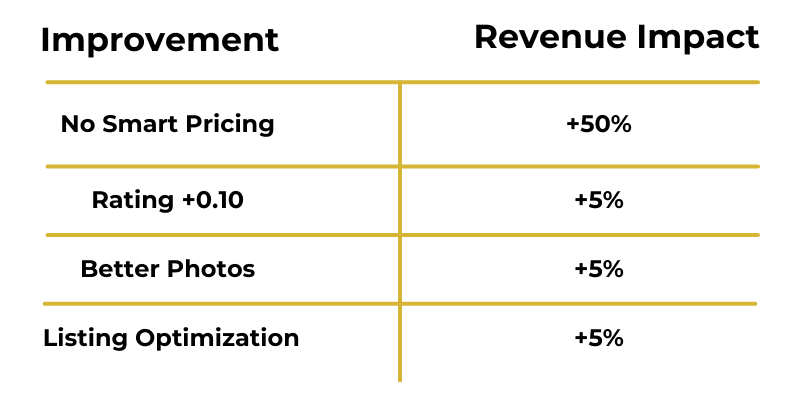
Plop some dates as if you were going to book and see if they are using dynamic pricing. If a host is not using dynamic pricing, there’s immediate room for revenue growth. This is the holy grail because just by setting up your dynamic pricing strategies, you can start earning more than the previous owner.
If you need help with pricing, check out my dedicated YouTube playlist.
Here, you can see the direct effect these aspects of the listing have on the revenue:
How Much Should You Offer For A Vacation Rental Property?
Once you find a promising property, you need to determine how much to offer based on your revenue projections. A good rule of thumb is a 5-year or less payback period.
To calculate:
Total Property Cost ÷ Estimated Annual Revenue = Payback Period
If the result is 5 or less, you’ve likely found a solid investment.
Example
Let’s say you found a property that checks everything we’ve talked about, and the purchase price is $600,000 and let’s say we got the following information from our research:
Yearly Occupancy = 85%
Nightly Rate = $600
Annual Revenue = (85% x 365 days) x $600 = $186,150
Now, we can calculate the payback period.
Payback Period = $600,000 ÷ $186,150 = 3.223 years
This would be a profitable investment.
Conclusion
Finding a profitable short-term rental isn’t about blindly following trend reports or trusting generic market lists. It’s about:
- Understanding your target guest.
- Check relevant data from multiple sources.
- Identifying hidden opportunities in micro-neighborhoods.
- Looking for underperforming properties with high improvement potential.
By following this method, you’ll uncover properties with untapped potential, just like I did with The Belmonte Penthouse, and buy a vacation rental property without too much risk.
Now, go find that winning investment!


